A loja já está disponível

Construímos máquinas Workstation AI para websites, agentes de IA e treino de LLM – configure e compre online.

Obter preços para revendedores
Produtos de IA
Laboratórios de IAAgentes OpenAIAgentes ClaudeBot GrokCRM nativo de IA Workstation AIMarketingTodos os produtos
Soluções de IA
IA aplicadaAgentes de IAIA generativaAutomação com IAFormação em IAPacotes de IA para PMELaboratório de IA empresarialWorkstations de IAHardware e software NVIDIAComputação acelerada NVIDIAIA privadaCloud privada de GPUClusters de GPUIA na edgeIA por setor
Serviços de IA
Modernização de plataformasEngenharia digitalFundações de dados e IAOperações autónomasConsultoria de IAAutomação DevOpsCibersegurançaDesenvolvimento de softwareCriação de agentesConfiguração de MLOpsLeasing de GPUCloud privada de GPU
Sobre nós
EmpresaA nossa históriaParceirosHistórias de clientes
Centros de dados de IA
Centros de dados de IACloud privada de GPUClusters de GPULeasing de GPU
Perspetivas sobre IASérie JevLaboratório de benchmarksSeleção de modelos
Notas técnicas
Documentação
Sistema operativo LinuxUbuntuRed Hat Enterprise LinuxSUSE LinuxAlpine LinuxDebian, Rocky e AlmaLinux
Plataformas de IA na cloudAWS e Amazon BedrockGoogle Cloud e Vertex AIMicrosoft Azure e AI FoundryClouds de GPU e marketplaces
Centros de dados de IA privadosPara escritórios de advogadosPara empresas de contabilidadePlataformas on-premisesCloud totalmente protegida
FerramentasRing PromoterJobshout
Notícias
Blogue
Contacte-nosIniciar sessão

Workstations de IA, software de IA multiagente, infraestrutura de GPU e soluções de agentes inteligentes para empresas modernas.

Contacte-nos

Soluções de IA

IA aplicadaAgentes de IAIA generativaAutomação com IAFormação em IAPacotes de IA para PMELaboratório de IA empresarialIA por setor

Produtos

Todos os produtosCRM e ERP nativos de IA Workstation AIMarketingAgentes OpenAIRing PromoterJobshout

Empresa

Sobre nósEmpresaCentros de dados de IAPorquê a WorkstationParceirosHistórias de clientesPreçosContactoTenthMatrix

Recursos

Perspetivas sobre IANotas técnicasDocumentaçãoSistema operativo LinuxPlataformas de IA na cloudCentros de dados de IA privadosBloguePesquisarMapa do site
Escritório na Bélgica
Workstation SRL, Rue Vanderkindere 34, 1180 Uccle, BrusselsBE 0751.518.683Seg – Sex: 9h00 – 18h00 CET
+32 492 45 67 46
Sede no Reino Unido
77-79 Marlowes, Hemel Hempstead HP1 1LFIndicações – saia na junção 20 da M25 (Outer London)N.º de registo da empresa: 11641870Seg – Sex: 9h00 – 18h00 GMT
+44 7515 356 146
Escritório na Índia
#159 Sector 9, Pocket 1, DDA Flats, 110077 Dwarka, New Delhi
+91 98881 98841
Escritório em Taiwan
3F, No. 2-4, Aisi Rd., Ren'ai Dist., Keelung City 200, Taiwan基隆市仁愛區愛四路2之4號3樓Seg – Sex: 9h00 – 18h00, hora de Taiwan (GMT+8)
+886 926 892 701+32 492 45 67 46
Escritório na Estónia
Aleksander Puškini tn 30-25, 20306 Narva, EstoniaSeg - Sex: 9h00 - 18h00, hora da Estónia (EET)
+32 492 45 67 46

© 2000-2026 Balinder Singh Walia. Todos os direitos reservados.

O sítio web Workstation e todo o seu conteúdo, bem como as APIs e plugins associados, são protegidos por direitos de autor de Balinder Singh Walia. balinder.walia@gmail.com

PrivacidadeEliminação de dadosCookiesTermos de serviçoMapa do site

NVIDIA, o logótipo NVIDIA, RTX, RTX PRO, Blackwell, CUDA, NVLink, MGX, Omniverse, Spectrum-X, Quantum, BlueField, DGX e HGX são marcas comerciais e/ou marcas registadas da NVIDIA Corporation nos EUA e noutros países. AMD, o logótipo AMD Arrow, EPYC, Instinct, Ryzen e Threadripper são marcas comerciais da Advanced Micro Devices, Inc. Dell e PowerEdge são marcas comerciais da Dell Inc. ou das suas subsidiárias. Intel e Xeon são marcas comerciais da Intel Corporation ou das suas subsidiárias. AMAX, AceleMax e LiquidMax são marcas comerciais da AMAX Engineering Corporation. Todos os outros nomes de produtos, logótipos e marcas são propriedade dos respetivos proprietários. Utilizamo-los apenas para identificar os produtos que descrevemos, fornecemos ou suportamos; a sua utilização não significa que os respetivos proprietários nos recomendem.

Loading blog...

Início / Blogues
DevOpsSecuritySREKubernetesAIAutomation

WSL Proxy WAF: Explainable Web Application Firewall at the Edge

Live policies, stages and signatures on Workstation WSL Proxy — monitor or block, with support IDs on every decision

Balinder Walia16 de setembro de 20263 min read
Workstation WSL Proxy WAF — Web Application Firewall

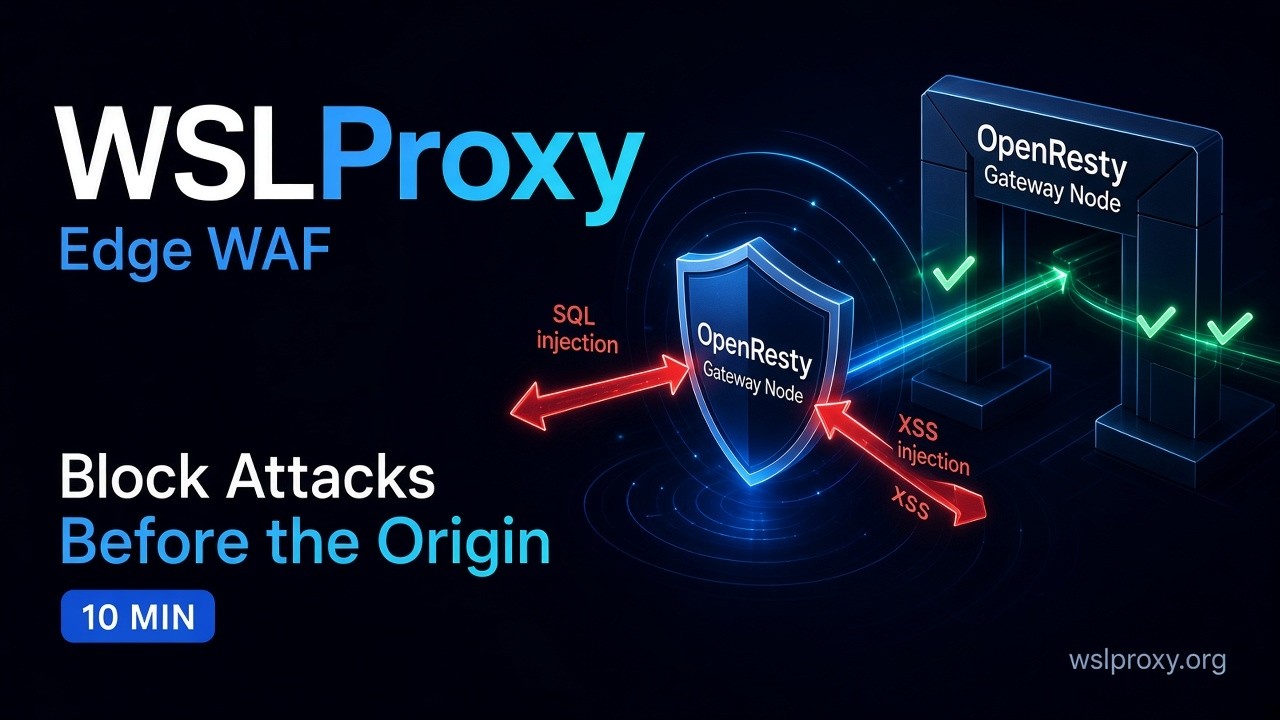
Workstation WSL Proxy puts a governed Web Application Firewall on the same live-config edge that routes and caches your traffic. Policies bind per domain and route, run in monitor or block, and every decision names a support ID. Companion deep dive: long article. Product: /wsl-proxy.

Workstation WSL Proxy WAF — Web Application Firewall

Watch: WSL Proxy WAF tour

Workstation WSL Proxy WAF tour

Watch: youtu.be/r10XSonA5JE · Product: wslproxy.org · WAF: wslproxy.org/waf

Bottom line. A WAF you cannot explain is a liability. Workstation WSL Proxy runs stages and governed signatures on the OpenResty request path after rate limiting, fails open by default so a WAF bug cannot take the site down, and returns X-WAF-* headers plus an X-Support-ID when it blocks.

The problem with opaque edge security

Most teams still protect APIs with a static nginx snippet, a shared ModSecurity pack nobody owns, or a cloud checkbox they cannot tune per route. When something breaks at 2 a.m., the ticket says “403 from the edge” with no policy name, no binding, and no safe way to dry-run a change. Reloading the whole POP for every rule change makes security and platform teams fight over the same config file.

Workstation WSL Proxy treats the edge as a product: live JSON and MCP configs for day-to-day routing and WAF, with nginx reloads reserved for listen and SSL changes. Security becomes operable — not a frozen regex list.

Where WAF sits in the pipeline

A request hits a POP. OpenResty accepts TLS and enters the Lua hot path. gateway_ack.lua matches a routing rule. The gateway pipeline then runs rate limits, then the WAF engine, then the response action and balancer. Typical outcomes include reverse-proxy to an upstream, redirect, static HTML, CAPTCHA challenge, or a 403 WAF block with support headers.

Inside the engine the order is fixed: load the policy, resolve the winning binding, run first-class stages, then governed signature matching and anomaly scoring. Each stage is fail-open under protected execution so an internal error logs and allows the request rather than blacking out the site.

What you get today

  • Policy packs bound per virtual host, with route and server overrides for monitor vs block.
  • Eight first-class stages before signatures: method allow-list, filetype deny, HTTP smuggling/desync, IP and geo deny, JWT algorithm policy, JSON depth/size, brute-force velocity, and OpenAPI positive security.
  • Governed signatures with stable IDs (SQLi, XSS, command injection, LFI, SSRF, SSTI, XXE, Log4Shell, Spring4Shell, JWT none, GraphQL introspection, scanner UAs, and related categories), plus disable / stage / set toggles and an anomaly threshold.
  • Explainable blocks: X-WAF-Block, X-WAF-Rule, X-WAF-Violation, X-Support-ID.
  • Layered edge controls on the same POP: per-server rate limit, CAPTCHA (rule status 306), JWT / S3 / cookie rule matches, and geo/IP routing rules independent of WAF stages.
  • Control plane: Admin UI, Swagger REST, MCP tools for Claude/Cursor, and wslproxy-cli pull/push for waf_rules and waf_policies.

Monitor first, then stage, then block

Binding precedence is deliberate: route override wins over per-server override, which wins over the policy default. That lets /preview stay in transparent (monitor/alarm) mode while /api/pay blocks. Signature stage windows alarm only until a timestamp and do not inflate the anomaly score — a safe rollout path before you flip a set to block.

Start in monitor on a staging POP or a low-risk path. Read structured wafsec logs and the events API. Promote sets when the noise is understood. Do not flip production to block without a soak.

Who it is for

Platform, SRE, and security teams who already run OpenResty or need an API gateway and CDN edge that security can actually operate. It is also for teams bringing AI agents to the same edge: MCP tools can already configure and inspect WSLProxy, while Agents Gateway and MCP Gateway integrations remain labelled in progress on the product page — not claimed as live WAF features.

Where to start

  1. Watch the tour above, then open wslproxy.org/waf.
  2. Read the technical article for stages, headers, and rollout practice.
  3. Explore the product overview at /wsl-proxy and the general intro at wslproxy.org.
  4. Engine deep dive: WAF Engine v2 blog · Engine v2 article.

Published by Workstation.

Product site: https://wslproxy.org · WAF: https://wslproxy.org/waf/