A loja já está disponível

Construímos máquinas Workstation AI para websites, agentes de IA e treino de LLM – configure e compre online.

Obter preços para revendedores
Produtos de IA
Laboratórios de IAAgentes OpenAIAgentes ClaudeBot GrokCRM nativo de IA Workstation AIMarketingTodos os produtos
Soluções de IA
IA aplicadaAgentes de IAIA generativaAutomação com IAFormação em IAPacotes de IA para PMELaboratório de IA empresarialWorkstations de IAHardware e software NVIDIAComputação acelerada NVIDIAIA privadaCloud privada de GPUClusters de GPUIA na edgeIA por setor
Serviços de IA
Modernização de plataformasEngenharia digitalFundações de dados e IAOperações autónomasConsultoria de IAAutomação DevOpsCibersegurançaDesenvolvimento de softwareCriação de agentesConfiguração de MLOpsLeasing de GPUCloud privada de GPU
Sobre nós
EmpresaA nossa históriaParceirosHistórias de clientes
Centros de dados de IA
Centros de dados de IACloud privada de GPUClusters de GPULeasing de GPU
Perspetivas sobre IASérie JevLaboratório de benchmarksSeleção de modelos
Notas técnicas
Documentação
Sistema operativo LinuxUbuntuRed Hat Enterprise LinuxSUSE LinuxAlpine LinuxDebian, Rocky e AlmaLinux
Plataformas de IA na cloudAWS e Amazon BedrockGoogle Cloud e Vertex AIMicrosoft Azure e AI FoundryClouds de GPU e marketplaces
Centros de dados de IA privadosPara escritórios de advogadosPara empresas de contabilidadePlataformas on-premisesCloud totalmente protegida
FerramentasRing PromoterJobshout
Notícias
Blogue
Contacte-nosIniciar sessão

Workstations de IA, software de IA multiagente, infraestrutura de GPU e soluções de agentes inteligentes para empresas modernas.

Contacte-nos

Soluções de IA

IA aplicadaAgentes de IAIA generativaAutomação com IAFormação em IAPacotes de IA para PMELaboratório de IA empresarialIA por setor

Produtos

Todos os produtosCRM e ERP nativos de IA Workstation AIMarketingAgentes OpenAIRing PromoterJobshout

Empresa

Sobre nósEmpresaCentros de dados de IAPorquê a WorkstationParceirosHistórias de clientesPreçosContactoTenthMatrix

Recursos

Perspetivas sobre IANotas técnicasDocumentaçãoSistema operativo LinuxPlataformas de IA na cloudCentros de dados de IA privadosBloguePesquisarMapa do site
Escritório na Bélgica
Workstation SRL, Rue Vanderkindere 34, 1180 Uccle, BrusselsBE 0751.518.683Seg – Sex: 9h00 – 18h00 CET
+32 492 45 67 46
Sede no Reino Unido
77-79 Marlowes, Hemel Hempstead HP1 1LFIndicações – saia na junção 20 da M25 (Outer London)N.º de registo da empresa: 11641870Seg – Sex: 9h00 – 18h00 GMT
+44 7515 356 146
Escritório na Índia
#159 Sector 9, Pocket 1, DDA Flats, 110077 Dwarka, New Delhi
+91 98881 98841
Escritório em Taiwan
3F, No. 2-4, Aisi Rd., Ren'ai Dist., Keelung City 200, Taiwan基隆市仁愛區愛四路2之4號3樓Seg – Sex: 9h00 – 18h00, hora de Taiwan (GMT+8)
+886 926 892 701+32 492 45 67 46
Escritório na Estónia
Aleksander Puškini tn 30-25, 20306 Narva, EstoniaSeg - Sex: 9h00 - 18h00, hora da Estónia (EET)
+32 492 45 67 46

© 2000-2026 Balinder Singh Walia. Todos os direitos reservados.

O sítio web Workstation e todo o seu conteúdo, bem como as APIs e plugins associados, são protegidos por direitos de autor de Balinder Singh Walia. balinder.walia@gmail.com

PrivacidadeEliminação de dadosCookiesTermos de serviçoMapa do site

NVIDIA, o logótipo NVIDIA, RTX, RTX PRO, Blackwell, CUDA, NVLink, MGX, Omniverse, Spectrum-X, Quantum, BlueField, DGX e HGX são marcas comerciais e/ou marcas registadas da NVIDIA Corporation nos EUA e noutros países. AMD, o logótipo AMD Arrow, EPYC, Instinct, Ryzen e Threadripper são marcas comerciais da Advanced Micro Devices, Inc. Dell e PowerEdge são marcas comerciais da Dell Inc. ou das suas subsidiárias. Intel e Xeon são marcas comerciais da Intel Corporation ou das suas subsidiárias. AMAX, AceleMax e LiquidMax são marcas comerciais da AMAX Engineering Corporation. Todos os outros nomes de produtos, logótipos e marcas são propriedade dos respetivos proprietários. Utilizamo-los apenas para identificar os produtos que descrevemos, fornecemos ou suportamos; a sua utilização não significa que os respetivos proprietários nos recomendem.

Loading blog...

Início / Blogues
AILLMMachine LearningGPUMLOpsPerformanceKubernetes

Turbocharging LLMs

PagedAttention, vLLM, Self-Debugging, PowerInfer, and EG-MLA — how to scale LLM agents without wasting GPU KV cache

Balinder Walia30 de agosto de 20263 min read
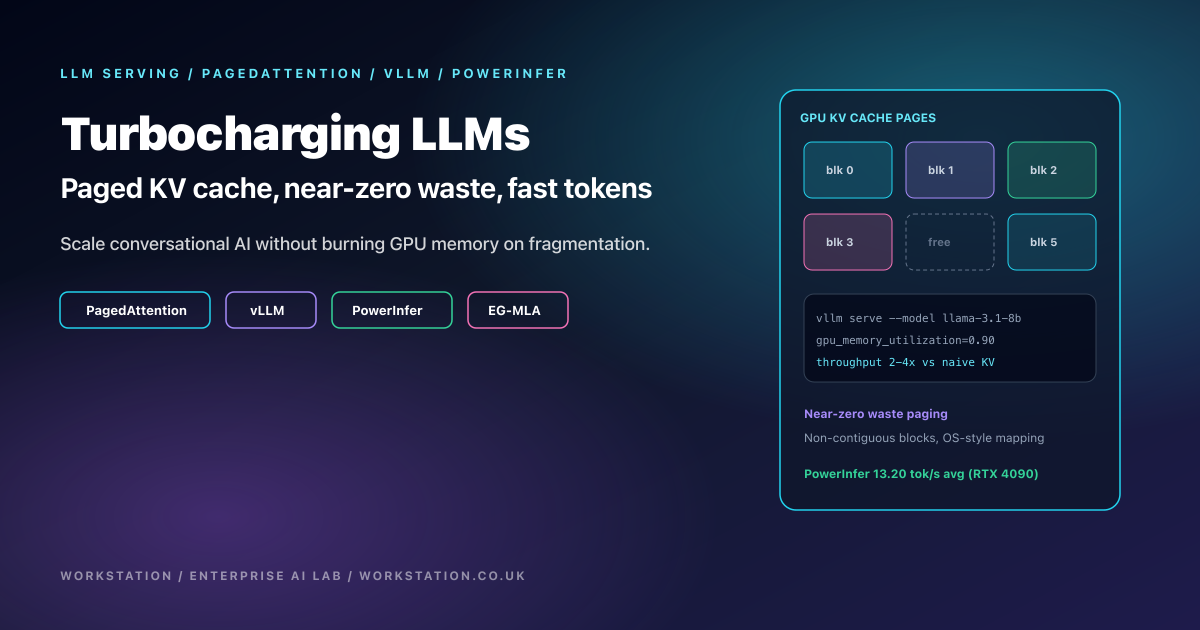
Turbocharging LLMs with PagedAttention, vLLM, PowerInfer and EG-MLA

Workstation on how to turbocharge large language models in production: PagedAttention, vLLM, Self-Debugging, PowerInfer, and EG-MLA — with the trade-offs that actually show up on GPUs. Deep dive: long article. Primer: LLMs explained + Kubernetes.
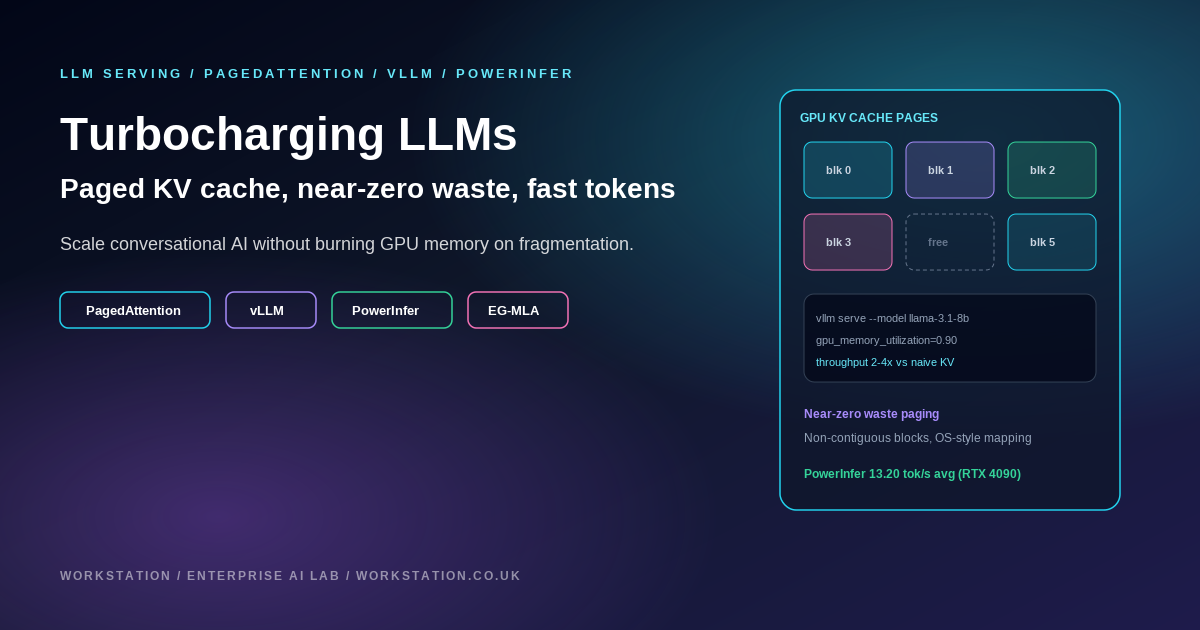
Turbocharging LLMs cover

Bottom line. Throughput dies when KV cache fragments. Page the cache like an OS (PagedAttention inside vLLM), pick a token engine that matches the box (PowerInfer on a fat consumer GPU, vLLM on a serving cluster), shrink attention when the architecture allows (EG-MLA), and cap agent debug loops so quality does not buy unbounded latency.

Watch: what an LLM actually is

Context, not a product demo: Intro to Large Language Models (Andrej Karpathy). Pair with our plain-English LLM + Kubernetes guide.

The scaling problem

LLMs unlocked conversational AI and generation, then immediately became a serving problem. Each decode step appends keys and values to a KV cache that grows with sequence length and batch size. Naive engines pre-reserve huge contiguous slabs. Most of that memory sits idle while other requests wait. Throughput collapses even though the GPU looks “full.”

PagedAttention: virtual memory for attention
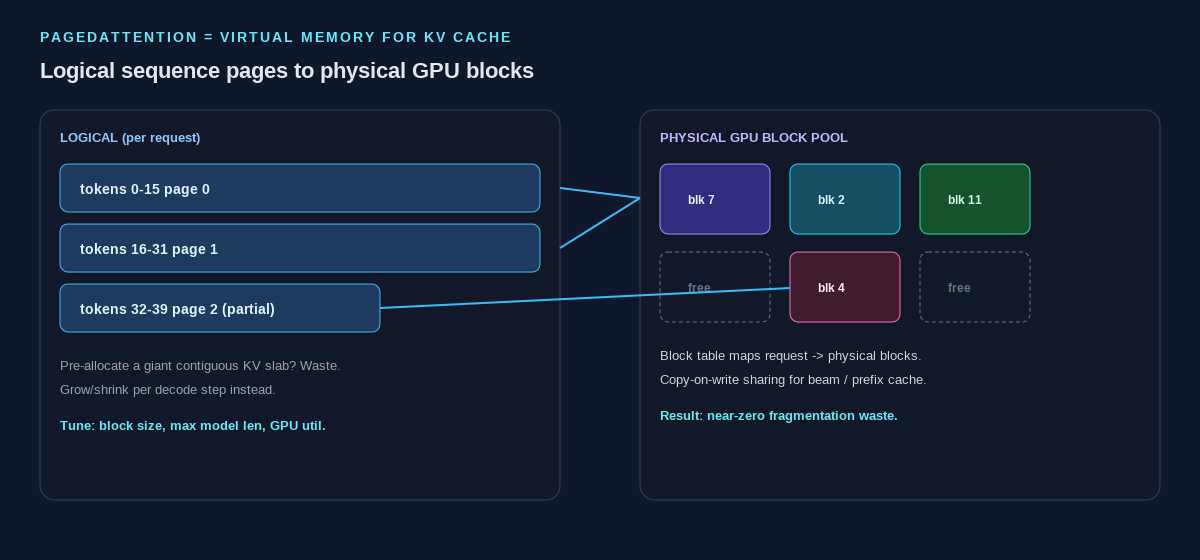
PagedAttention maps logical token pages to physical GPU KV blocks

PagedAttention (Kwon et al., SOSP 2023) treats KV cache like OS paging: fixed-size blocks, a block table per request, non-contiguous physical pages [arXiv:2309.06180]. The kernel gathers blocks at attention time. You still must tune block size, max model length, and the cache hierarchy (GPU HBM vs CPU offload vs prefix cache). Too-small blocks add mapping overhead; too-large blocks reintroduce waste.

vLLM: near-zero waste serving

vLLM is the serving system built around PagedAttention. It targets near-zero KV waste, continuous batching, and an OpenAI-compatible HTTP surface. In production, watch three things: (1) gpu_memory_utilization vs OOM, (2) time-to-first-token vs decode tokens/s, (3) whether prefix / prompt caching changes answers for your eval set. Caching is a throughput win; it is not free of correctness and tail-latency effects.

from vllm import LLM, SamplingParams

llm = LLM(model="meta-llama/Llama-3.1-8B-Instruct", gpu_memory_utilization=0.90)
params = SamplingParams(temperature=0.2, max_tokens=256)
outs = llm.generate(["Explain PagedAttention in one paragraph."], params)
print(outs[0].outputs[0].text)

That is real vLLM usage. A Hugging Face BERT forward() call is not PagedAttention — do not confuse classifier logits with paged KV serving.

Self-Debugging: quality loops with a latency budget

Self-Debugging (Chen et al.) teaches a model to fix its own predicted programs from few-shot traces, matching or beating baselines that emit 10x more candidates [arXiv:2304.05128]. For agents, that is gold — until feedback rounds stack. Cap the number of debug messages, log each round, and fail closed to a human or a smaller specialist model when the budget is gone.

Watch: serving and inference context

Contextual talk on fast LLM serving — not an official Workstation demo. Pair with the vLLM paper and docs.vllm.ai.

PowerInfer: tokens on a single fat GPU

PowerInfer splits hot/cold neurons so a consumer GPU plus CPU can generate tokens quickly. Reported figures: 13.20 tokens/s average, peak 29.08 tokens/s on one NVIDIA RTX 4090, up to 11.69x vs llama.cpp while keeping accuracy [PowerInfer]. At fleet scale you still need placement: which layers stay on GPU, how you shard across nodes, and whether the locality profile of your prompts matches the paper’s models.

EG-MLA: shrink the KV without wrecking the bench

EG-MLA (embedding-gated multi-head latent attention) reports over 91.6% KV cache reduction vs multi-head attention with negligible degradation, extra savings vs MLA (up to 59.9%), and better scores on reasoning suites, scaled past 1B parameters [EG-MLA paper]. Treat it as an architecture choice, not a drop-in flag on a frozen vLLM checkpoint — validate your eval harness before you celebrate the memory graph.
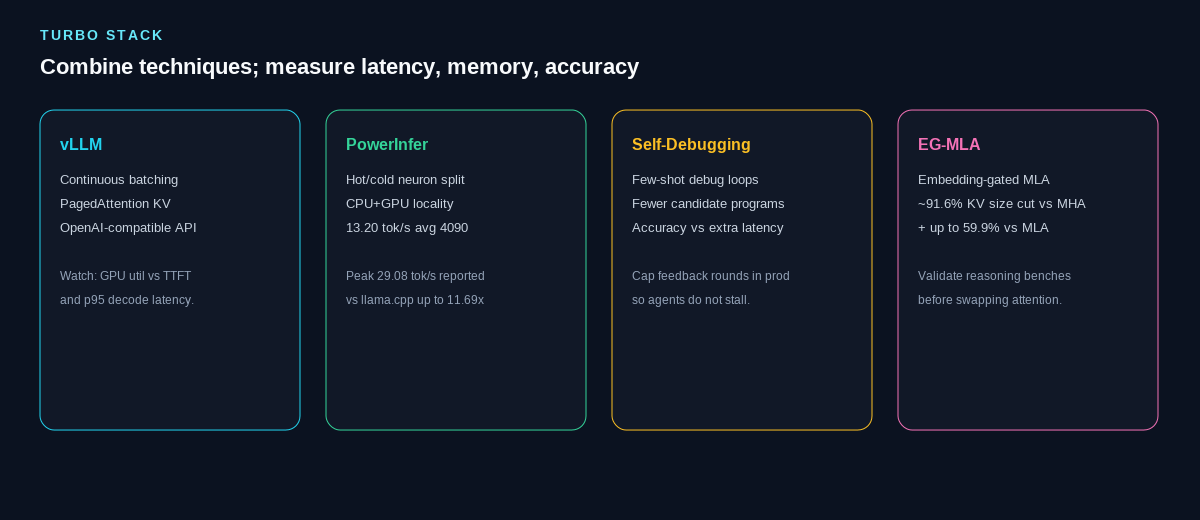
vLLM, PowerInfer, Self-Debugging and EG-MLA stack

Putting it together

Combine PagedAttention + vLLM for cluster serving, PowerInfer when the box is a workstation GPU, Self-Debugging inside coding agents with a hard round limit, and EG-MLA when you control the model family. Distributed serving adds complexity: KV parallelism, prefill/decode split, and autoscaling that does not thrash the page tables. Measure. Then write the ADR.

Read next

  1. Long article — knobs, failure modes, Kubernetes notes.
  2. LLMs explained + run your own on Kubernetes
  3. Muse Glimmer / local agents · Enterprise AI Lab

Published by Workstation.