The AI Guidance Gap: Use Outpaces Training at School and at Work

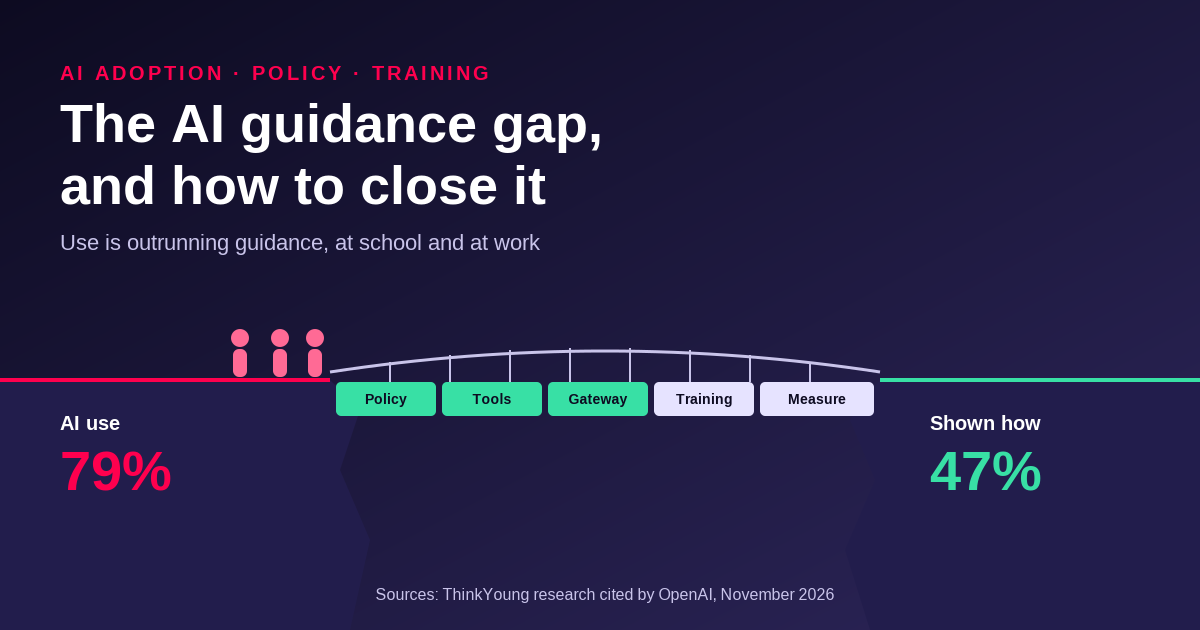
People are adopting AI faster than anyone is teaching them to use it. New research cited by OpenAI finds that 79% of secondary-school students use AI for homework, but only 47% have been shown how. The same gap exists at work, and in a company it shows up as leaked data, unchecked output and agents wired to systems nobody approved. Here is how to close it.
For developers: AI Usage Policy as Code: Build an LLM Gateway with PII Redaction, Tool Allow-Lists and Telemetry has the code, a tested FastAPI gateway with Presidio redaction, allow-listed MCP tools, red-team tests and a usage report.
What the research found
On 10 November 2026 OpenAI published "Closing the AI guidance gap in education", drawing on new research by ThinkYoung, a Brussels-based youth think tank, and on OpenAI's education partnerships in Europe, the Middle East and Africa [1]. The headline: 79% of surveyed students reported using AI for homework or assignments, but only 47% said they had been shown how. OpenAI calls this "a guidance gap, not an access gap" [1]. OpenAI supported the study, so treat it as vendor-backed research until ThinkYoung publishes the full report with its method.
Two points in OpenAI's own framing deserve attention. First, the post argues that teachers matter more, not less, as models improve, because AI without expert judgement does not build knowledge or independent thinking. Second, it is candid that the evidence so far shows adoption, not learning: outcomes need sustained measurement [1].
The workplace picture is similar and older. Microsoft and LinkedIn's 2024 Work Trend Index, a survey of 31,000 people in 31 countries, found that 75% of knowledge workers used AI at work, 78% of those users brought their own tools, and only 39% had received AI training from their employer [2]. Sixty per cent of leaders said their company lacked a plan to implement AI [2]. The numbers will have moved since 2024, but the shape is the same as the school survey: use first, guidance later.

Why the gap costs a business money
In a school the gap shows up as weaker learning. In a company it turns into four concrete risks.
- Data leaving by the side door. When 78% of AI users bring their own tools [2], client names, contracts and source code go into services your company has no contract with, no retention terms for and no audit trail of. OWASP lists sensitive information disclosure as the second most serious risk for LLM applications [8].
- Unchecked output. People who were never shown how to verify AI output tend to trust the first answer. The cost lands later, as rework, a wrong figure in a client report or a bug in production.
- Agents raise the stakes. An agent does not just draft text; it calls tools. The Model Context Protocol (MCP), the standard way to connect AI assistants to tools and data, has more than 10,000 active public servers, according to Anthropic, which donated it to the Linux Foundation's new Agentic AI Foundation in December 2025 [4]. An untrained employee can connect an agent to a mailbox or a CRM in minutes.
- Compliance. If you provide or deploy AI systems in the EU, Article 4 of the EU AI Act requires you to take measures to support your staff's AI literacy [5]. The July 2026 Digital Omnibus kept that duty but made clear it is an obligation of effort, not a guaranteed competence level for each person [6]. A documented training and policy programme is how you show the effort.
Signal's president Meredith Whittaker put the agent problem in numbers at the 39C3 conference: if each step of a task succeeds 95% of the time, a 10-step task succeeds about 60% of the time and a 30-step task about 21%; at 90% per step, 30 steps succeed about 4% of the time [3]. That is simple compounding (0.95 to the power of the step count), and it is why a human checkpoint before an irreversible action is not optional.

A 90-day playbook to close the gap
The aim is to make the safe way the easy way. Google's engineering team found that AI features people must remember to trigger "have failed to scale", while ones built into the existing workflow succeed [7]. Guidance works the same way: a PDF nobody opens changes nothing; a blocked request that explains why, with a link to the rule, teaches.
- Find out what is really happening (weeks 1–2). Run a short anonymous survey (which tools, for what tasks, with what data) and check expense claims and web proxy logs for AI services. Do not punish what you find; you need honest answers.
- Write a one-page policy by data type, not by tool (weeks 2–3). Tools change monthly; data classes do not. Say what each class of data may be used with (see the table below), what must always be checked by a human, and who to ask.
- Provide approved tools (weeks 3–6). Buy business plans with data-retention terms you have read, or host models yourself for confidential work. If the approved option is worse than a personal account, people will keep using the personal account.
- Put a gateway in front of every model (weeks 4–8). One internal endpoint that checks the policy, redacts personal data, logs every request and counts usage per team. Existing tools keep working because the gateway speaks the same API. Our technote has a working one.
- Train by role, on real tasks (weeks 6–10). One hour, not a generic course: how to prompt for the team's actual work, how to verify (sources, tests, a second reader), what data never goes in, and how to record that AI was used.
- Control agents separately (weeks 8–12). Allow-list the MCP servers and tools each team may use, give them read-only credentials by default, and require human approval for anything that writes, sends or pays.
- Measure and adjust (ongoing). Track use, blocked requests by reason, redactions by team and use that nobody labelled. A team with many blocks needs guidance, not a reprimand.

Before and after
| Area | Ungoverned (the gap) | Guided |
|---|---|---|
| Tools | Personal accounts, unknown retention | Approved business or private models through one gateway |
| Policy | None, or a ban nobody follows | One page, by data class, linked from every block message |
| Personal data | Pasted into prompts | Redacted automatically before it leaves |
| Output | First answer trusted | Checked against sources or tests; AI use recorded |
| Agents | Any MCP server, full credentials | Allow-listed servers, read-only by default, approval for writes |
| Visibility | Discovered after an incident | Usage, blocks and redactions per team on a dashboard |
| Training | Self-taught | Role-based, on real tasks, refreshed when tools change |
Checklist
- We know which AI tools staff actually use, and for what.
- A one-page AI policy exists, organised by data class, with a named owner.
- Approved tools are as convenient as personal ones.
- All model traffic goes through a gateway that redacts, logs and counts.
- Every team has had role-specific training on verification and data handling.
- Agents use allow-listed tools with least-privilege credentials; writes need approval.
- We review usage, blocks and redactions monthly and update guidance from them.
- For EU-facing work, training and policy records support our AI literacy measures.
Common mistakes
- Banning instead of guiding. Use moves to personal phones and you lose all visibility.
- Policies by product name. They are out of date by the next release. Write rules by data class and task.
- Logging full prompts forever. The audit log becomes the biggest store of personal data you have. Log metadata and hashes; keep content only where you must, with a retention limit.
- Treating redaction as perfect. Automated detection misses things. It reduces risk; it does not replace the rule that restricted data never goes in.
- Measuring only adoption. High use says nothing about quality. Track rework, verification and incidents too, as OpenAI admits for education [1].
- Giving agents the user's full permissions. An agent with a person's mailbox and CRM rights can do everything that person can, at machine speed (OWASP calls this excessive agency [8]).
What to do this week
- Send a five-question anonymous survey on AI use, tools and data types.
- Draft the one-page data-class table and get a named owner to sign it off.
- List every AI service you already pay for and check its data-retention terms.
- Ask engineering to stand up a test gateway from our technote and route one team through it.
- Book a one-hour, role-specific verification session for the team that uses AI most.
If you want help building the gateway, private model hosting or a policy your teams will actually follow, our enterprise AI team does this work with UK organisations.
References
- Closing the AI guidance gap in education, OpenAI, 10 November 2026 (citing ThinkYoung research).
- Microsoft and LinkedIn release the 2024 Work Trend Index on the state of AI at work, Microsoft, 8 May 2024.
- Signal President and VP warn agentic AI is insecure, unreliable, and a surveillance nightmare, Coywolf, 11 January 2026 (report of the 39C3 talk "AI Agent, AI Spy").
- Donating the Model Context Protocol and establishing the Agentic AI Foundation, Anthropic, 9 December 2025.
- EU AI Act, Article 4: AI literacy, artificialintelligenceact.eu.
- EU AI Act: AI Omnibus recalibrates Article 4, AI literacy remains mandatory, KI-Campus, 28 July 2026.
- AI in software engineering at Google: progress and the path ahead, Google Research, 6 June 2024.
- OWASP Top 10 for LLM Applications 2025, OWASP GenAI Security Project.