AI Factories for Industry

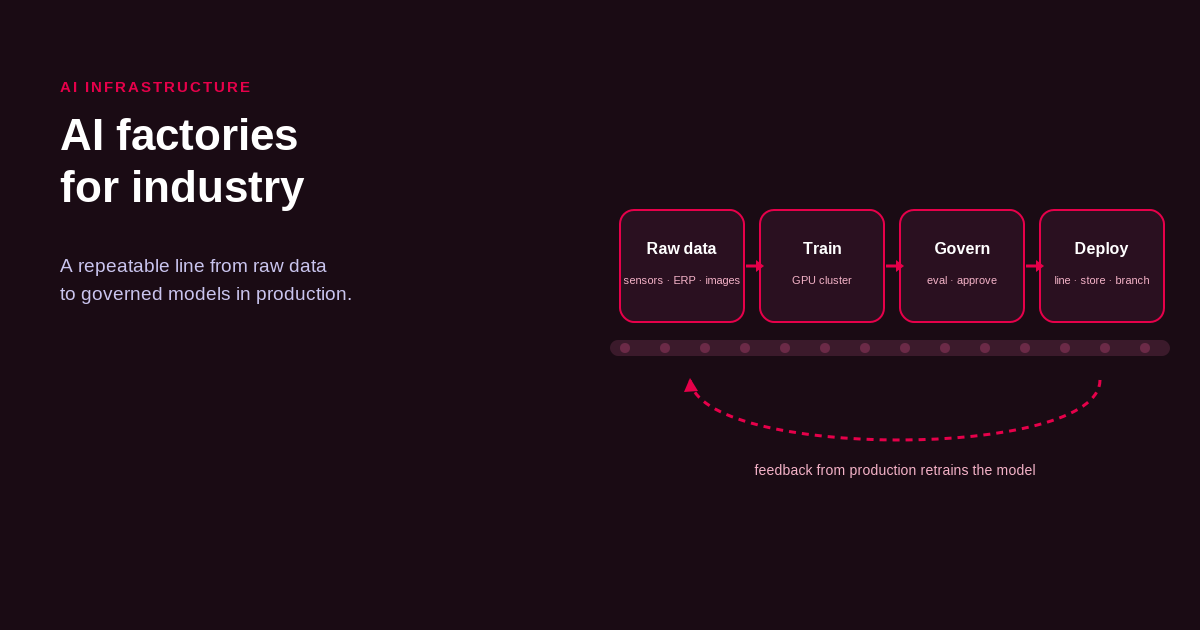
AI Factories are not a single product. They are a reproducible operational system that turns raw operational data into trained, governed models and then into deployed decisions, with the same discipline as a physical factory. An AI Factory differs from ad-hoc AI projects by standardizing data products, training, validation, deployment and monitoring into repeatable pipelines with quality control, versioning and rollback. The focus of AI in science has shifted from model training to adapting and applying AI to specific domains, projects, and questions [1]. That shift is what makes the factory metaphor useful for industry readers who care about throughput, quality control, and repeatability rather than research novelty.
The EGI Federation has provided federated e-infrastructure services to European and global science for over 15 years [1]. Its strategy is instructive for industry builders. The AI strategy emerging from the EGI Federation Strategy 2026-2030 is organised around three enablers: 1) an AI-ready infrastructure connecting compute, data, and application resources across the continuum; 2) human skills to know what is possible with AI and how to implement it; and 3) trust, to run AI with confidence even in high-risk environments [1]. EGI specialises in the customisation and long-term operation of AI for research [1]. The same three enablers map directly to manufacturing lines, supermarket back offices, banks, schools, clinics, and tax agencies.
Building AI Factories for Manufacturing
For plant engineers an AI Factory means sensor data to predictive maintenance, quality, and scheduling without manual rework each time a line changes.
A typical flow is ingestion from PLCs and vision systems, feature engineering per asset class, model training and validation, and closed-loop deployment to MES. The factory framing forces decisions about data ownership per line, model versioning per SKU, and rollback criteria.
The hardware choice matters for edge vs central training. NVIDIA DGX Spark is designed for AI developers, researchers, data scientists, and students who need powerful, always-on AI compute on the desktop—without relying on cloud or data center access for every workload [2]. The unit has a 10 GbE RJ-45 Ethernet port [3] and two QSFP ports driven by NVIDIA ConnectX-7 NIC capable of up to 200 Gbps [3]. Two interconnected DGX Sparks can handle models with up to 405 billion parameters in FP4 [3], and the device has 128 GB of coherent unified system memory, shared seamlessly between the CPU and GPU [3].
For shop-floor pilots the power and form factor are practical constraints. The NVIDIA DGX Spark has a power consumption of 170W [4] and 128GB of LPDDR5X memory, with a memory bandwidth of 273GB/s [4]. Up to 4 DGX Spark systems can be connected using NVIDIA ConnectX-7 networking [2], and the NVIDIA DGX Spark supports 200GbE clustering with a second unit [4]. DGX Spark ships with DGX OS and additional NVIDIA tools, including the NVIDIA NeMo framework for model fine-tuning and the NVIDIA RAPIDS libraries for accelerated data science [2].
In manufacturing the benefit is reduced unplanned downtime and better first-pass yield. The challenge is data fragmentation across vendors, change management with operators, and the need for trust in high-risk environments, which aligns with the trust enabler noted in the EGI strategy [1].
Applying AI Factories in Retail
Supermarkets operate on thin margins and perishable inventory. An AI Factory here is demand forecasting, dynamic pricing, and loss prevention running as scheduled jobs with clear SLAs.
The factory must handle POS, loyalty, weather, and promotional calendars as distinct data products. Human skills to know what is possible with AI and how to implement it [1] are critical because category managers need explainable recommendations, not black boxes.
Benefits are reduced waste and improved stock availability. Challenges are data privacy at checkout, seasonality, and integration with legacy ERP. Retail AI Factories also require change management with store staff and clear governance for pricing decisions to maintain customer trust. Success depends on data product ownership per category and repeatable validation before price changes go live.
Implementing AI Factories in Finance
Banking and FinTech share regulatory scrutiny and real-time requirements. An AI Factory for finance separates experimentation from production with formal model risk management.
Core capabilities include fraud detection, credit underwriting, and chat-based support. The EGI emphasis on an AI-ready infrastructure connecting compute, data, and application resources across the continuum [1] translates to banks needing a single data mesh for core banking, payments, and third-party data.
Benefits are faster decisions and lower fraud loss. Challenges are explainability, auditability, and trust to run AI with confidence even in high-risk environments [1]. Additional challenges include model validation cycles aligned to regulatory reporting, data lineage for audit, and skill gaps in bridging risk and data science teams.
A simple comparison of deployment patterns:
| Pattern | Latency | Data locality | Typical use |
|---|---|---|---|
| Edge inference on store/branch | <50 ms | On-prem | Fraud scoring at POS |
| Centralized batch factory | Minutes-hours | Central lake | Credit model retraining |
| Hybrid with model sync | Seconds | Hybrid | Personalization |
Deploying AI Factories in Education
Schools and universities need personalization at scale without creating surveillance risks. An AI Factory for education produces tutoring assistants, grading aids, and administrative automation as governed services.
The factory must respect FERPA/GDPR, provide teacher oversight, and avoid vendor lock-in. The human skills enabler is central: teachers need to know what is possible with AI and how to implement it [1].
Benefits are reduced administrative load and adaptive learning paths. Challenges are equity of access, bias in assessment data, and change management. Implementation also requires curriculum alignment, data minimization for minors, and ongoing teacher training to maintain pedagogical control. The factory must support explainable outputs and allow human review of automated decisions.
Using AI Factories in Healthcare
HealthTech requires the strongest trust controls. An AI Factory here means imaging analysis, triage prioritization, and operational scheduling with clinical validation gates.
The EGI strategy’s three enablers map well: AI-ready infrastructure connecting compute, data, and application resources across the continuum [1]; human skills to know what is possible with AI and how to implement it [1]; and trust, to run AI with confidence even in high-risk environments [1].
Benefits are faster diagnosis support and resource utilization. Challenges are regulatory approval, data governance across hospitals, and liability.
Applying AI Factories in Taxation
Tax authorities and tax preparation firms need accuracy, audit trails, and seasonal surge capacity. An AI Factory for tax returns automates document classification, anomaly detection, and taxpayer assistance.
The factory must handle strict data residency and immutable logs. The focus on adapting and applying AI to specific domains, projects, and questions [1] is evident here: models are fine-tuned to tax code, not general language.
Benefits are reduced processing time and fewer errors. Challenges are model drift with law changes and public trust. Specific operational challenges include seasonal load spikes, secure handling of personally identifiable information, and maintaining auditability for every automated decision. Benefits also include standardized taxpayer guidance and faster refunds.
Challenges and Benefits of AI Factories
Benefits are consistent across sectors: repeatability, faster iteration, and measurable ROI once pipelines mature. Hardware like DGX Spark shows how scale-out can be approached incrementally: the enterprise manageability features developed for DGX Spark 128 GB can also be applied to DGX Spark 64 GB [2].
Common challenges are data quality, skills gaps, and governance. The EGI view is useful: long-term operation requires customisation and sustained operation, not just a one-off model [1]. Organizations that treat AI as a product line with quality control, not a project, are the ones that succeed.
A minimal factory definition file can help teams align:
factory:
  domain: manufacturing_quality
  data_products:
  - vision_inspection
  - sensor_telemetry
  training_schedule: weekly
  validation_gates:
  - drift_threshold: 0.05
  - human_review: true
  deployment_target: edge
  trust_controls:
  - audit_log
  - model_card
AI Factories are sector-specific in examples and constraints, but the underlying pattern is shared. The work is less about novel models and more about reliable adaptation, which is exactly the current shift in AI practice [1].
To implement, start with one bounded data product and a defined quality gate, secure the three enablers of AI-ready infrastructure, human skills and trust, and operate the pipeline as a product with ownership, SLAs and measurable outcomes.
References
- AI in the EGI e-infrastructure -- Past experiences and future strategies — arxiv.org
- NVIDIA DGX Spark: AI Supercomputer on Your Desk — nvidia.com (24 August 2025)
- NVIDIA DGX Spark In-Depth Review: A New Standard for Local AI Inference - LMSYS Org — lmsys.org (14 October 2025)
- The NVIDIA DGX Spark is a Tiny 128GB AI Mini PC Made for Scale-Out Clustering — servethehome.com (1 April 2025)